02. PLC vs Relay
Difference between Programmable Logic Controller (PLC) and Relay?
In this tutorial, I am explaining each and every point considering the difference between them, the advantages of PLC over relay, and vice-versa.

Basic Introduction to Relay and PLC
Dive into some of the basic questions and doubts most of us we have…
What is Relay?
A relay is an electro-mechanical operator switch. In the earlier days, different types of relays are used for the electric protection/controlling system.
It is a hardware switching device to control the electrical circuit by using switching logic.
What is PLC?
Now a day, Programmable Logic Control (PLC) is a mini computerized industrial controller that controls the circuit.
Read in detail: What is Programmable Logic Control (PLC)?
In PLC, The basic concept of an electronic controlling system is to convert simulate the functional logic into different PLC brands’ software for automation. So, it provides a software-based solution.
Is Relay the same as PLC?
For the controlling electro-mechanical system, the basic functions of both Relays and PLCs are the same in the industries.
Then why PLC?
What is the Advantage of PLC over Relay?
If we compare the relay with PLC, PLC systems perform better in terms of work, accuracy. PLC requires less time, less wiring.
PLC is easy to maintain. There will not be much physical work. PLC has more advanced functions as compared to manual work (hardware relay-base).
These are the main reasons, why the industries are shifting to use PLCs over the relay.
What is the Disadvantage of Relay?
The main disadvantage is, the relay needs more wiring for performing different functions.
Now, let’s start understanding the working, different functions, and operations of both PLC and Relay in detail…
Top 13 Difference Between PLC and Relay Based Controller
Comparing PLC vs Relay tablewise!
| # | Contents | PLC | Relay |
| 01 | Basic | Programmable Logic Control (PLC) is a solid-state computerized industrial controller that performs software logic by using i/o, CPU, memory. | Relay is an electro-mechanical switching hardware device (Hardware Switching Device). |
| 02 | Function | PLC plays monitoring as well as controlling role in designing circuits. | Relay plays only a controlling role in the designing circuit. Monitoring is not so easy with a relay. |
| 03 | Working | In the PLC, we can write the program. | In the Relay, we cannot write the program. |
| 04 | Operation | PLC is operated on the digital system. | Relay is operated on the analog system. |
| 05 | Function | PLC consists of more programming functions like timer, counter, memory, etc. | Relay gives only one fault detection function. And it does not have much-advanced functionalities. |
| 06 | Design | You can easily modify the designing circuit. | Modification of the electronic circuit is more difficult as compared to PLC. |
| 07 | I/O | PLC have more capabilities of inputs and outputs. | The relay does not have more capabilities. |
| 08 | Flexibility | PLC provides more flexibility than the relay. | The relay provides less flexibility. |
| 09 | Fault | You can easily find the fault by using the software. | It is very hard to find fault in the Relay circuit. |
| 10 | Time | PLC has a time response of nearly 50 msec and above. | Relays have less than 10 msec response time. |
| 11 | Memory | It consists of memory to store the program. | It does not consists of memory. |
| 12 | Types | There are two types of PLC as,Compact PLCModular PLC | Following the list of types of relayElectromagnetic RelayThermal RelayInduction Relay |
13. Picture of PLC Hardware and Relay (How does it look?)
In the following picture, you are looking at a compact PLC and Relay hardware device.
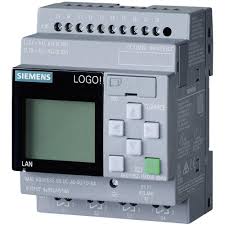
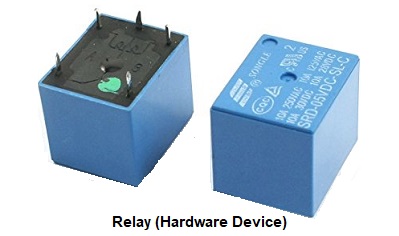
Both the PLC nad Relay hardware, you will get. Check here, PLC hardware module, and the hardware relay.
From this tutorial, I have covered the 13 different points between them. You find few similarities as both are used as controllers.
But, they are different from working, operations point of view. This also shows the advantages of PLC over programmable Relay.
If you have any point or queries over the difference between plc and relay, please comment.
PLC Related Read:
- Learn here, Compact PLC Vs Modular PLC
