Virtual Local Area Network (VLAN)
What is VLAN
A Virtual Local Area Network (VLAN) is a network topology which allows to logically instead of physically segment a LAN into several net segments. A VLAN combines a group of hosts with a common set of requirements logically instead of physically relocating devices or connections.
In traditional medium sharing Ethernet and switched Ethernet, all users are in a broadcast domain. With more and more PCs appearing in the networking, broadcast packets increase, which greatly increases data flow among devices in the networking. Thus, network performance becomes worse. With networking expands, broadcast storm may occur and the entire network may be paralyzed.
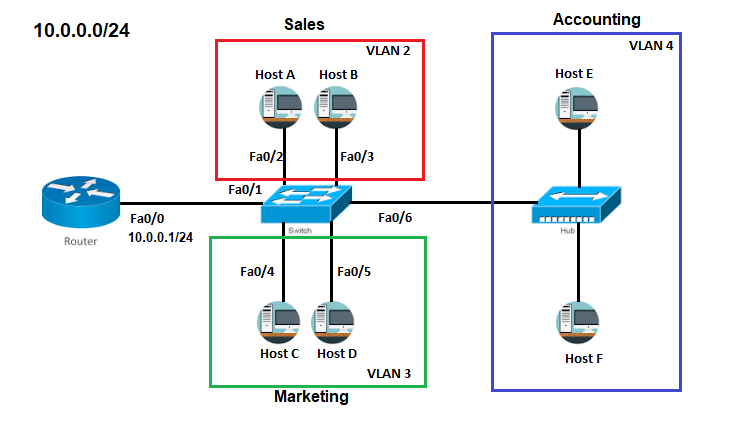
VLANs allow a network to be logically segmented into different broadcast domains. All members in a VLAN are treated as in the same broadcast domain and communicate as if they were on the same net segment, regardless of their physical locations. Logically, a VLAN can be equated to a broadcast domain, because broadcast packets are forwarded to only members of the VLAN on which the broadcast was initiated. Different VLANs cannot intercommunicate directly. Inter-VLAN communication can only be achieved using a router or other layer 3 devices that are able to perform Layer 3 forwarding. VLAN network topology can be shown as below:
VLAN Advantages
Better network performance: By restricting all broadcast traffic to a VLAN, it saves network bandwidth and enhances network performance.
Reduced cost: The use of VLANs to create broadcast domains eliminates the need for traditional routers to handle this function, permitting operation at lower latencies and cost compared to routers under heavy load and at high cost.
Ease of network management: Members of a VLAN group can be geographically dispersed as they are logically related instead of physically on the same VLAN. Thus network administrators do not need to re-configure the network when a VLAN member changes its location.
Better network security: PCs in different VLANs cannot intercommunicate directly. Inter-VLAN communication can only be achieved using a router or other layer 3 devices that are able to perform Layer 3 forwarding, which can ensure better security for different departments in enterprise networking.
